WP Admin > Job Manager > Settings is the page where you can configure the plugin. You’ll see a tabbed interface showing available setting groups:
Plugins such as Job Alerts may add their own settings tabs as well.
General Settings
The General tab contains the following settings:
- Date Format – Choose how you want the published date for jobs to be displayed on the front-end.
- Google Maps API Key – Enter your Google Maps API key (you can acquire one here). Google requires an API key to retrieve location information for job listings.
- Delete Data on Uninstall
- Bypass Trash for Job Listings
- Enable Usage Tracking
Job Listings settings
The job listings tab contains the following settings:
- Listings per page – Controls how many job listings should be shown per page when using the [jobs] shortcode.
- Pagination Type – Determines whether to show page numbered links or a Load More listings button.
- Filled positions – If checked, filled positions will no longer be visible when using the [jobs] shortcode
- Hide expired listings – If checked, expired job listings are not searchable and are kept off the public job board. Enabled by default. Expired listings stay in wp-admin either way – see Archiving old listings.
- Hide Expired Listings Content – If checked, the content within expired listings will be hidden: anyone opening an expired listing by its direct URL sees the title and “This listing has expired.” in place of the job description. Enabled by default.
- Categories – If checked, job categories will be enabled. These are used to group jobs by category and are also visible on the frontend job submission form if enabled.
- Multi-select Categories – If enabled, the category select box will default to a multiselect on the [jobs] shortcode.
- Category Filter Type – Determines the logic used to display jobs when selecting multiple categories.
- Types – Choose whether you want to enable types.
- Multi-select Listing Types – If enabled, each job can have more than one type.
- Salary – If enabled, this lets users add a salary when submitting a job.
- Salary Currency – If enabled, this lets users enter a custom salary currency when submitting a job.
- Default Salary Currency – You can specify a default currency for all job listings (e.g.,
USD). You can enter any currency symbols into the text field. - Salary Unit – If enabled, this lets users add a salary unit when submitting a job from the following: Year, Month, Week, Day, or Hour
- Default Salary Unit – You can set the default period unit by choosing one of the following: Year, Month, Week, Day, Hour.
- Location Display – If enabled, this displays the full address of the job listing location when it is detected by Google Maps Geocoding API. If a full address is not available, it will then display whatever text the user submitted for the location.
Job Submission settings
The job submission tab shows options regarding the job submission process in WP Job Manager:
- Account Required – If left unchecked, non-logged in users will be able to submit job listings without creating an account.
- Account Creation – If checked, non-logged in users will be able to create an account by entering their email address on the job submission form. This is optional depending on the settings below.
- Scheduled Listings – If enabled, a Scheduled Date field is added to the job submission form, allowing employers to set a future date for the listing to be published (schedule a job listing, post-date a listing, publish a listing later). The listing goes live automatically when that date arrives, and in the meantime the employer can see it on the job dashboard. The date must be in the future – if the field is left blank, or the date is not valid or is in the past, the listing is published immediately. If Moderate New Listings is also enabled, a scheduled listing still requires admin approval before it can go live.
- Account Username – If enabled, a username will be generated from the first part of the user email address. Otherwise, a username field will be shown.
- Account Password – When enabled, an email will be sent to the new user with their username and a link to set their password. If disabled, a password field will be shown and the new user’s email address won’t be verified.
- Account Role – If you enable registration on your job submission form, choose a role for the newly registered users. This defaults to Employer.
- Moderate New Listings – If enabled, new submissions will be inactive, pending admin approval. Only once approved by an admin (published) will they be visible on the frontend.
- Allow Pending Edits – If enabled, submissions awaiting admin approval can be edited by the user.
- Allow Published Edits – Controls whether users can edit their published listings, and whether those edits need approval. Choose from Users cannot edit, Users can edit without admin approval (the default), or Users can edit, but edits require admin approval. With the moderated option, the original listing is unpublished while the edit awaits an admin’s approval.
- Listing Duration – How many days listings are live before expiring. Can be left blank to never expire. Published jobs will automatically be set to expire based on this setting. Please note that WC Paid Listings can override this setting.
- Renewal Window – Sets how many days before expiration users are offered the option to renew a listing from the job dashboard. For example, entering
7offers renewal one week before the listing expires. Defaults to5. Enter0to disable renewals entirely. Renewal applies only to published listings that have an expiration date, so it is unavailable when Listing Duration is left blank. - Listing Limit – How many listings are users allowed to post. Can be left blank to allow unlimited listings per account.
- Application Method – Choose the contact method for listings. You can accept an Email address or website URL (the default), or restrict submissions to Email addresses only or Website URLs only.
- Company Logo Max Size – The maximum file size for company logo uploads, in kilobytes. Leave blank to use your server’s maximum upload size. Entering a value larger than your server’s upload limit will not raise that limit.
- Terms and Conditions Checkbox – Requires employers to check a Terms and Conditions box before a job listing can be submitted. Note that WP Job Manager does not create this page or its contents for you. Once created, select it as the Terms and Conditions Page under Job Manager > Settings > Pages.
CAPTCHA Settings
Note: there’s a known compatibility issue with reCAPTCHA v3 and WP Job Manager. You can apply this code snippet as a temporary fix. This code snippet reference is for guidance only and we cannot guarantee that they will always work as expected.
WP Job Manager (and the Applications and Resume Manager add-ons) have ReCAPTCHA support built in. To enable it, you’ll need to set up a ReCAPTCHA key at Google’s ReCAPTCHA admin dashboard.
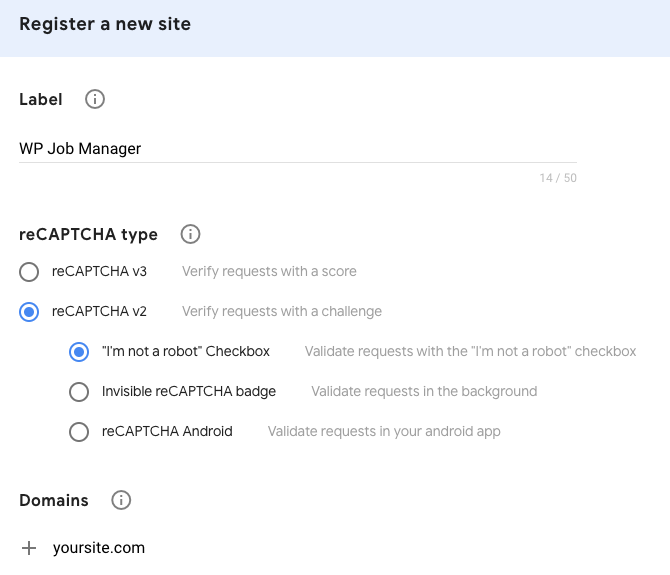
You will then be provided with a site key and a secret key, which you can enter in the ReCAPTCHA settings page on your site. To enable captcha, navigate to the CAPTCHA tab from the Settings page.

- Field Label – The label used for the reCAPTCHA field on forms.
- Site Key – You can get this from the Google ReCAPTCHA admin dashboard.
- Secret Key – You can get this from the Google ReCAPTCHA admin dashboard.
- Job Submission Form – Enable this to display the ReCAPTCHA field on your job submission form.
Pages
The pages tab allows you to select the pages where you’ve inserted the main WP Job Manager shortcodes, along with the page linked from the Terms and Conditions checkbox.
- Submit Job Form Page: Select the page where you have placed the
[submit_job_form]shortcode. - Job Dashboard Page: Select the page where you have placed the
[job_dashboard]shortcode. - Job Listings Page: Select the page where you have placed the
[jobs]shortcode. - Terms and Conditions Page: Select the page to link from the Terms and Conditions checkbox on the submission form. This applies when Terms and Conditions Checkbox is enabled in the Job Submission settings.
Job Visibility
The Job Visibility tab controls who can see your job listings (restrict job listings, hide jobs from the public, members-only job board). Both settings accept WordPress roles and capabilities, and both are empty by default, which displays as Everyone (Public) — meaning anyone, including logged-out visitors, can see your listings.
- Browse Job Capability – Select the roles or capabilities that allow visitors to browse the job listings page. Leave this empty to let everyone browse listings.
- View Job Capability – Select the roles or capabilities that allow visitors to open an individual job listing. Leave this empty to let everyone view listings.
The two settings are applied separately, so every role that should be able to see your job listings must be added to both. For example, if only Candidates are added, Employers will not be able to view the jobs page.
Multisite
WP Job Manager can be used on multisite installations. However, please note that it will not sync data between subsites.
Each subsite in a multisite network requires its own license activation for our add-ons. The key must be entered on each subsite individually, and each activation counts against that subsite’s own domain. A Personal license allows two activations, while a Developer license allows unlimited activations, so a single Developer license covers every subsite in your network. See the Account, Billing, License FAQ for details.